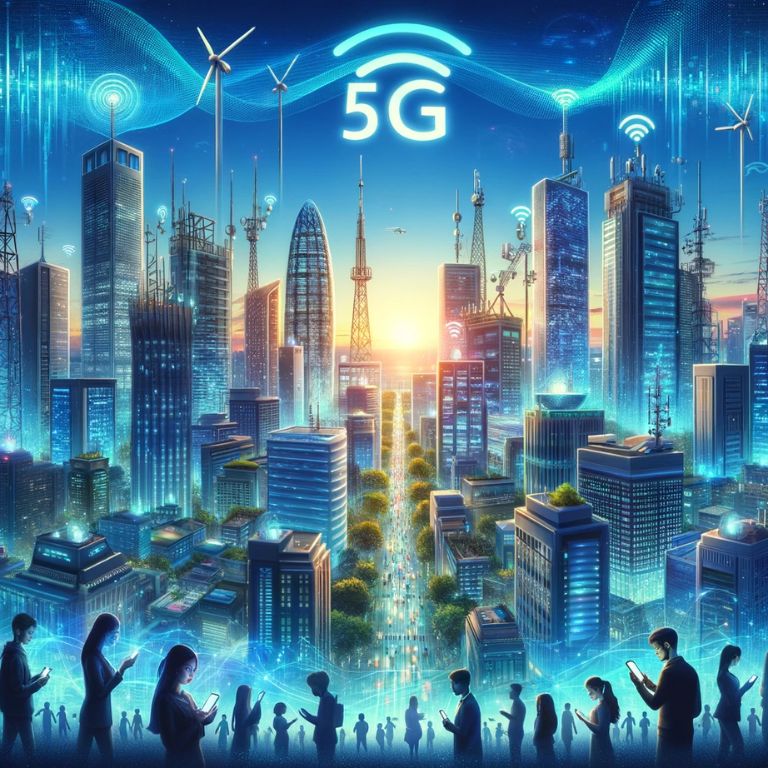
The world of mobile internet is about to change dramatically with the arrival of 5G technology. It promises faster speeds, lower delays, and the ability to connect many more devices at once. This new generation of wireless networks will impact how we communicate, work, and live.
In this article, we will explain what 5G technology is, how it works, its benefits, challenges, and what it means for the future.
What Is 5G Technology?
5G stands for fifth generation wireless technology. It is the latest standard for mobile networks, following 4G (LTE), 3G, and earlier generations.
5G networks provide much faster internet speeds, more reliable connections, and the ability to support a massive number of connected devices simultaneously.
How Does 5G Work?
5G uses new technologies and frequency bands to achieve its high performance:
1. Higher Frequency Bands
5G uses higher radio frequencies called millimeter waves (mmWave), which can carry more data at very high speeds but have a shorter range.
2. Small Cells
To cover areas where mmWave signals don’t reach far, 5G uses many small cell towers that work together to provide continuous coverage.
3. Massive MIMO
Multiple-Input Multiple-Output (MIMO) technology uses many antennas to send and receive data, increasing capacity and speed.
4. Beamforming
This technology directs wireless signals in focused beams towards devices rather than broadcasting in all directions, improving efficiency and reducing interference.
Benefits of 5G Technology
- Faster Speeds: Up to 100 times faster than 4G, enabling quick downloads and smooth streaming.
- Lower Latency: Response time drops to just 1 millisecond, ideal for real-time applications like gaming and remote surgeries.
- More Connections: Supports up to 1 million devices per square kilometer, perfect for smart cities and IoT networks.
- Improved Reliability: Stable connections with fewer drops.
- Energy Efficiency: Better power management for connected devices.
Applications of 5G Technology
1. Smart Cities
5G enables smart lighting, traffic management, and public safety systems by connecting millions of sensors and devices.
2. Internet of Things (IoT)
Thousands of devices like home appliances, wearables, and industrial equipment can connect seamlessly.
3. Autonomous Vehicles
Self-driving cars rely on ultra-fast, low-latency communication with other vehicles and infrastructure.
4. Healthcare
Remote surgeries and telemedicine become more feasible with real-time data transmission.
5. Entertainment
Enhanced VR/AR experiences, 8K video streaming, and cloud gaming require high-speed networks.
6. Industry 4.0
Smart factories use 5G to connect robots, machines, and sensors for automation and efficiency.
Challenges of 5G Technology
- Infrastructure Costs: Building new small cells and upgrading networks is expensive.
- Coverage Issues: High-frequency waves don’t travel far or penetrate buildings well.
- Security Concerns: More connected devices increase potential attack points.
- Device Compatibility: Older devices may not support 5G.
- Health Myths: Some concerns about radiation, though studies show 5G is safe within limits.
How 5G Will Shape the Future
5G will be the backbone for future technologies:
- Smart Homes: Connected devices will automate daily tasks.
- Education: Remote learning with immersive VR classrooms.
- Work: Seamless video conferencing and remote collaboration.
- Environment: Better monitoring and management of natural resources.
Conclusion
5G technology is more than just faster internet—it’s a platform that will enable new innovations across industries and improve everyday life.
As 5G networks expand worldwide, we will see smarter cities, better healthcare, and more connected devices shaping a new digital era.