Have you ever wondered how Netflix knows what movie you’ll enjoy next? Or how your phone automatically suggests words while you type? The answer is Machine Learning — one of the most exciting parts of modern technology.
Machine Learning, often called ML, is changing the way we live, work, and communicate. It’s behind many tools we use every day — from smart assistants to self-driving cars. But what exactly is Machine Learning, and how does it work? Let’s find out in simple words.
🌍 What Is Machine Learning?
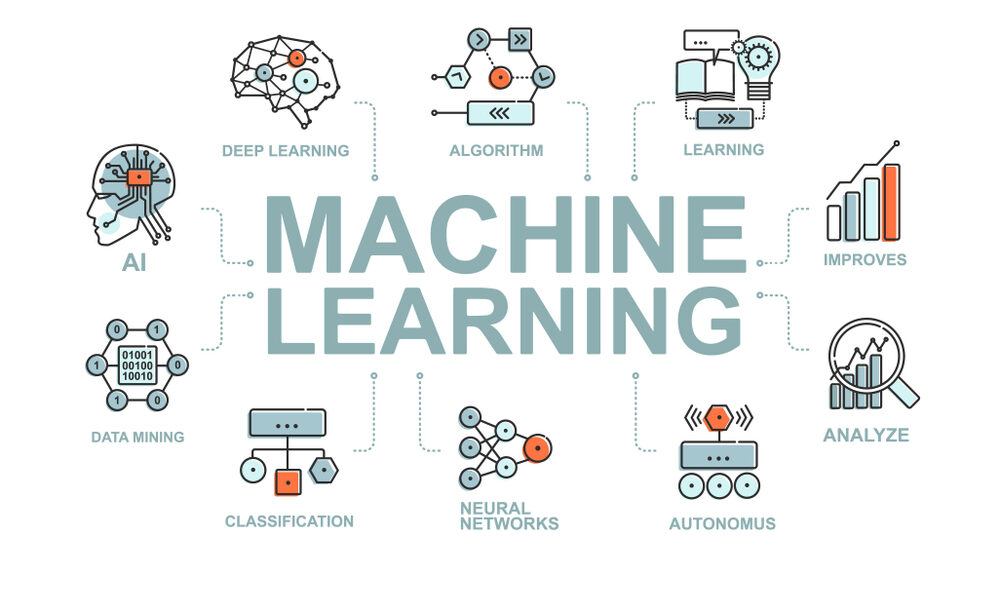
Machine Learning is a branch of Artificial Intelligence (AI) that allows computers to learn from data without being directly programmed.
In simple terms, instead of telling the computer exactly what to do step by step, we give it examples and let it figure out patterns on its own.
For example, if you show a computer thousands of pictures of cats and dogs, it can learn to tell which is which — even when you show it a new photo it has never seen before.
That’s the magic of machine learning: computers learning and improving automatically through experience.
🧠 How Does Machine Learning Work?
Machine Learning works in three basic steps:
- Collect Data: First, we gather information — such as text, images, numbers, or sounds.
- Train the Model: The computer studies this data and learns patterns using special algorithms.
- Make Predictions: Once trained, it can make predictions or decisions on new data.
Here’s a simple example:
Imagine you want to create a machine learning model that predicts the weather.
- You give it data about temperature, humidity, and rainfall for the past few years.
- The computer studies the data and finds patterns.
- Then, it can predict tomorrow’s weather based on what it learned.
That’s how most ML systems work — by learning from the past to predict the future.
⚙️ The Main Types of Machine Learning
There are three main types of Machine Learning. Let’s understand each one with examples.
1. Supervised Learning
In supervised learning, the computer is trained with labeled data — that means the answers are already known.
For example, if you’re training an ML model to recognize fruits, you give it images labeled “apple,” “banana,” or “orange.”
The system learns what each fruit looks like and then predicts new ones correctly.
This is the most common form of machine learning used today — in spam filters, fraud detection, and recommendation systems.
2. Unsupervised Learning
Here, the data has no labels. The computer must figure out the hidden patterns on its own.
For example, if you give the model thousands of photos without telling it what’s in them, it might group similar pictures together — maybe one cluster of cats, another of cars, and another of trees.
Unsupervised learning is used in data analysis, market segmentation, and customer behavior research.
3. Reinforcement Learning
In this type, the computer learns by trial and error — just like humans.
It gets rewards for good actions and penalties for bad ones.
This is how robots learn to walk or how AI plays games like chess or Go better than humans.
Reinforcement learning is also used in self-driving cars and industrial automation.
📊 Real-Life Examples of Machine Learning
Machine Learning is everywhere around us. Here are some easy-to-understand examples:
- Email Filtering: Gmail uses ML to detect spam messages.
- Voice Assistants: Siri, Alexa, and Google Assistant learn your voice and improve responses.
- Online Shopping: Websites suggest products you might like based on your previous searches.
- Social Media: Facebook and Instagram show you posts you’re most likely to enjoy.
- Healthcare: ML helps doctors detect diseases like cancer from X-rays.
- Finance: Banks use ML to detect fraud and analyze credit risk.
- Transportation: Self-driving cars use ML to understand their surroundings.
Machine Learning quietly works behind many of our favorite apps and services.
🔢 Data: The Fuel of Machine Learning
Machine Learning runs on data, just like cars run on fuel.
The more data you give to a model, the better it learns and the more accurate it becomes.
But data quality matters too. If you train an ML model with poor or biased data, it will make wrong predictions.
For example, if an ML system for job recruitment is trained on biased data, it may unfairly favor certain candidates.
That’s why data scientists spend a lot of time cleaning and preparing data before training a model.
🧩 Popular Machine Learning Algorithms
Machine learning uses algorithms — sets of mathematical rules — to learn from data.
Here are a few simple and common ones:
- Linear Regression: Used to predict numbers, like house prices or sales.
- Decision Trees: These models make decisions by splitting data into smaller parts.
- Random Forest: A group of many decision trees that vote on the best answer.
- K-Means Clustering: Used for grouping similar data points.
- Naive Bayes: A simple model often used for email spam detection.
- Neural Networks: These mimic how the human brain works and power deep learning.
Each algorithm has different strengths and is chosen based on the problem being solved.
🧠 What Is Deep Learning?
Deep Learning is a special kind of machine learning that uses neural networks — systems inspired by the human brain.
These networks can handle complex data like images, video, or voice.
Deep learning is what allows AI to recognize faces, translate languages, or even write text (like ChatGPT does!).
For example:
- Deep learning helps Google Translate understand sentences in different languages.
- It helps self-driving cars identify pedestrians and traffic signs.
- It powers facial recognition systems on smartphones.
In short, deep learning is the technology behind many of today’s “smart” systems.
🏭 Where Machine Learning Is Used
Machine Learning is changing almost every industry. Let’s see how:
1. Healthcare
ML helps doctors diagnose diseases, discover new drugs, and predict patient health risks.
2. Education
AI and ML create personalized learning systems that adapt to each student’s needs.
3. Banking and Finance
ML detects fraud, automates trading, and assesses credit risks.
4. Transportation
From route optimization to self-driving cars, ML makes travel safer and faster.
5. Retail
Stores use ML to track customer preferences and manage inventory efficiently.
6. Agriculture
Farmers use ML to predict crop yields and detect plant diseases.
7. Entertainment
Streaming services like Netflix use ML to recommend movies and shows.
Machine learning truly touches every part of modern life.
🌱 Advantages of Machine Learning
Machine Learning brings many benefits to individuals and businesses:
- Automation: ML can perform repetitive tasks faster than humans.
- Accuracy: Models can analyze large amounts of data and find patterns humans might miss.
- Efficiency: ML saves time and money by automating workflows.
- Personalization: It tailors content and services to each user’s preferences.
- Innovation: ML leads to new inventions in robotics, medicine, and climate research.
⚠️ Challenges of Machine Learning
Despite its power, ML also has some challenges:
- Data Privacy: ML needs lots of data, which can include personal information.
- Bias: If data is biased, the model can make unfair or incorrect decisions.
- High Cost: Training complex models requires expensive hardware and large datasets.
- Lack of Transparency: Some ML models are so complex that even experts can’t fully explain how they make decisions.
- Job Impact: Automation can reduce some human jobs, though it also creates new ones.
Developers and governments are working to ensure that ML is used ethically and responsibly.
🧮 How to Learn Machine Learning
If you want to get started with Machine Learning, you don’t need to be a genius — just curious and patient. Here’s a simple learning path:
- Learn the Basics of Python: It’s the most popular programming language for ML.
- Understand Mathematics: Especially statistics, probability, and linear algebra.
- Try Online Courses: Websites like Coursera, Udemy, and Khan Academy have beginner-friendly ML courses.
- Practice on Datasets: Platforms like Kaggle offer free data and competitions.
- Use ML Tools: Try simple tools like Scikit-learn, TensorFlow, or PyTorch.
- Keep Learning: The world of ML changes fast, so stay updated through tech blogs (like TechCascade.online!).
🌐 The Future of Machine Learning
The future of Machine Learning looks bright. Here’s what we might see in the coming years:
- Smarter AI Assistants: They’ll understand emotions and context better.
- Healthcare Revolution: AI will predict diseases before symptoms appear.
- Personalized Education: Students will learn with AI tutors that adapt to their needs.
- AI in Creativity: ML will help create music, art, and even movies.
- Environmental Protection: ML will help track climate change and save endangered species.
Machine Learning is not just a trend — it’s a key part of the future of technology.
💬 Final Thoughts
Machine Learning is one of the most powerful inventions of our time. It helps computers learn from experience, make decisions, and solve complex problems.
From smartphones to hospitals, from farming to space exploration — ML is changing everything. But with great power comes great responsibility. We must use it carefully, protecting privacy and ensuring fairness.
As Machine Learning continues to grow, it will make our world smarter, safer, and more connected — one algorithm at a time.